Being Human for a Better Tomorrow in the Age of AI
Explore vistas, gain insights, and chart your path across work, life, business, society, and civilization. Subscribe to stay tuned and inspired: Subscribe
Mindvista Edition 78 examined whether three years of AI development had simply improved the original tools or changed the materials available to enterprise builders. Its conclusion was that the builder’s library has expanded enough to mark a Second Age.
AI can perceive and know more through multimodal models, long context and retrieval. It can connect and act through function calling, connectors and code execution. It can persist and choose through working loops, retained state and model routing. The change is significant enough for enterprises to begin building for it.
Those materials are not equally ready. Edition 78 placed them across four judgments that belong to the complete task rather than to the model. A task may be ready to use within a proven boundary, ready to pilot through limited real work, ready to explore through a proof of concept that answers a defined unknown, or unproven or overstated where the claim runs beyond the end-to-end evidence.
If that is how the technology evolved, the next question is how enterprise adoption changed alongside it. In Mindvista Edition 57 we saw Enterprise AI adoption moving slowly towards enterprise-wide access, application by application, measured through usage, token consumption and APIs embedded in workflows. That was a reasonable way to learn, and many bounded assistants continue to create value without a new enterprise architecture.
The Second Age changes what users can ask of AI. A task can now assemble context from structured records, documents, images and conversations, retain an earlier interpretation across several steps, move through an established workflow, and then read, recommend, communicate or write.
What changes is not only the scale of what can be attempted but the consistency and reliability the enterprise must now provide. Questions the First Age did not have to answer at scale become unavoidable.
Which source is authoritative, whose authority travels with the action, and how is a partial change recovered? How does the system remain dependable as models and tools change? How do the people affected retain the ability to understand, influence and recover?
Those are not questions each application can answer on its own. They are architectural questions, and they require policies that hold across tasks.
The decisions leaders make now about direction, policy and design will determine whether AI capability accumulates into dependable enterprise systems or remains a collection of local successes.
This edition examines why local success does not automatically become enterprise capability, what architecture the Second Age requires, how that architecture can be calibrated and remain adaptable.
McKinsey’s 2026 global survey found that 80% of respondents said AI had improved their individual productivity, yet only 37% attributed any positive EBIT contribution to AI. An IBM study of 2,000 CEOs adds the scaling signal: half believed the pace of investment had left them with disconnected, piecemeal technology, and only 16% had scaled enterprise-wide. These are self-reported surveys and do not prove that architecture alone caused the gap. They do show that individual assistance, a successful application and enterprise value are different achievements.
A bounded assistant often succeeds because its user supplies what the application does not. The employee chooses the relevant information, carries the answer into the next system, notices an implausible result and remains accountable. As AI takes on more of the complete task, those implicit human connections must become explicit system responsibilities: which information governs, whose authority it carries, which action is valid, what changed and whether the outcome was achieved.
Recent incidents show what happens when connection advances further than those responsibilities. EchoLeak brought untrusted external content into contact with privileged enterprise retrieval. An Asana MCP flaw exposed a failure in tenant isolation. Air Canada’s chatbot supplied information that conflicted with the airline’s policy, and the tribunal held the airline accountable for what its customer had been told. These were different failures, of trust boundaries, isolation and authoritative representation, but each occurred where a locally useful capability met an enterprise boundary it could not define for itself.
The AI boundary is much wider than one application calling another. It extends across complex data sources, integrity, authority and execution rights.
A complete task may now aggregate structured records with documents, images, speech or video, retain an earlier interpretation and move through an established workflow before reading, recommending or writing back.
Structured systems of record carry declared owners, fields and transaction rules. Much of the unstructured enterprise context now within reach has no equivalent single source of truth. A policy may have been superseded without disappearing. An amendment may sit apart from its contract, or an image may supply evidence without becoming an authoritative record. Multimodal capability extends what the enterprise can perceive while making provenance, interpretation, permission and evidential status more important.
The distinction between loops that read and loops that write makes the consequence clearer. A read loop can still mislead an employee or customer, expose restricted information or conceal a conflict. A write loop can additionally alter enterprise state, communicate a commitment or trigger another process. As the loop moves from private assistance to externally consequential action, identity, delegated authority, data validity, transaction integrity and traceability must deepen with it.
These judgments cannot wait for a platform to be complete, but neither can every use case invent them independently. For each complete task, the enterprise must decide which sources are authoritative, what context is permitted, whether the task may only read or may also write, whose authority travels with it and how the outcome can be challenged or recovered. Repeated decisions reveal the policies and shared contracts that should become institutional rather than local.
Leaders therefore face two unattractive extremes. Leaving every decision local preserves speed but repeatedly recreates the same boundaries. Centralising every application and process into one platform can slow learning and weaken domain ownership. The more useful direction is a narrow shared architecture: a small set of enterprise policies and contracts applied consistently, with execution and experience remaining close to the domains that understand the work.
Enterprise workflows and integrations already carry approvals, dependencies and exception rules accumulated over years. Giving AI access to applications does not mean it understands that operating context. Edition 66 gave us an early architecture for the relationship between records, execution and shared context. The Second Age now requires us to re-examine it.

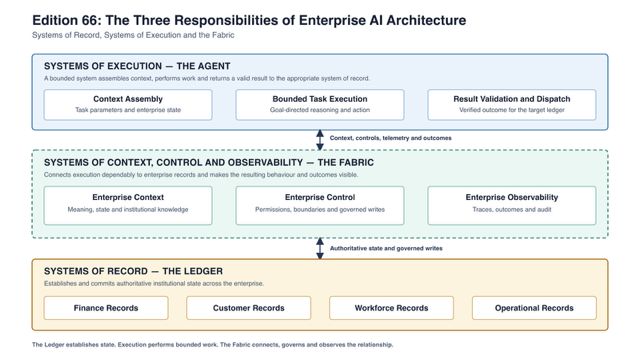
The architecture represented in Edition 66 was itself a significant First Age advance. It separated three responsibilities that are often compressed into an application or AI stack.
Systems of Record commit authoritative enterprise state. Systems of Execution perform bounded work. Between them, Systems of Context, Control and Observability supply grounding, controls and visibility. These are responsibilities, not three prescribed products.
Diagram 1 shows the three responsibilities around the more bounded AI execution of the First Age. The ledger established the institutional state, the agent performed a defined task, and the Fabric connected the two. Those responsibilities remain different.
The Second Age changes what passes between them and how consistently their boundaries hold.
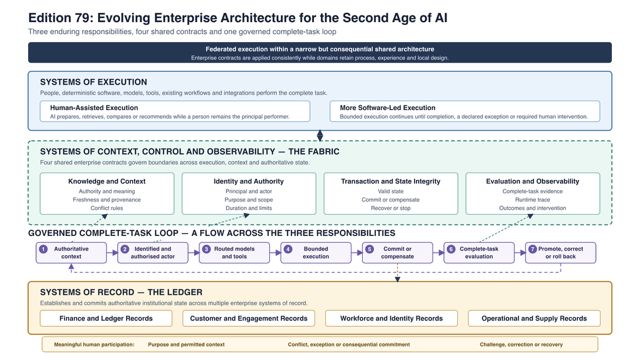
Systems of Execution now include human-assisted and more software-led work. In one, AI retrieves, compares or recommends while a person remains the principal performer. In the other, software, models and tools continue through bounded steps until completion, exception or required human intervention. Both run through inherited workflows and integrations, not beside them. Application access does not reveal all the approvals, dependencies and exceptions those workflows contain, or the institutional memory they carry.
Context has expanded beyond structured records to documents, conversations, images, speech and retained interpretations. Tasks can route among models and tools, carry state and move from reading to writing or communicating for the enterprise. Edition 66’s responsibilities endure, but the Fabric’s consequential obligations become explicit shared contracts.
Diagram 2 shows how those responsibilities evolve. The four contracts are shared so that every relevant task applies them consistently, not merely because components might be reused.
A dependable basis for knowing distinguishes available information from authoritative context. Air Canada’s chatbot demonstrated the consequence of conflicting with enterprise policy. EchoLeak showed how untrusted content could influence privileged retrieval.
The contract establishes authority and meaning, freshness and provenance, and rules for conflict. It identifies which source governs, how current it needs to be, where an interpretation came from and when disagreement should halt the task or reach a person. More context improves what AI can perceive; it does not decide what the enterprise should believe.
Knowing who may act requires more than passing a credential to the next tool. The architecture distinguishes the human principal from the software actor, carries the task’s purpose and scope, and sets its duration and limits. The Asana MCP flaw showed how useful connection can become exposure when tenancy and authority do not travel correctly across a boundary.
Authority is delegated for a defined purpose rather than inherited from an ambient service account. Consequential calls carry the principal, actor and permitted action. That authority must also expire, so a permission created for today’s task should not continue acting tomorrow without re-authorisation merely because its credential remains technically valid.
Identity and transaction integrity are related but separate. Permission to attempt an action is not proof that the resulting state change is valid. Applications often collapse the two; the architecture should not.
Once execution can write, communicate a commitment or trigger another process, the enterprise governs the state it creates. The Replit production-database incident showed how quickly software-led execution can cross into consequential and difficult-to-recover change. Multi-step work does not become a reliable transaction because a model treats it as one task. An early action may succeed while a later one fails, leaving an unintended state.
The contract defines valid state, when a change commits, how partial change is compensated and when execution recovers or stops. Authoritative systems commit according to declared enterprise policy; AI-enabled execution may propose or invoke changes only within explicit authority and recovery arrangements. This is the determinism boundary. Consequential permissions, transaction controls and stopping mechanisms must be enforced outside probabilistic model reasoning, in dependable infrastructure rather than only in a prompt.
A technically successful call is not evidence that the complete task worked. Evaluation establishes what success means and tests readiness before deployment; observability preserves a runtime trace of context, models, tools and state changes. LongHorizon-Harness research reinforces the point: separating management, execution and audit, and retaining only verified task state, materially improved extended-task reliability.
The contract joins complete-task evidence, runtime trace, and outcomes and intervention. It shows whether the promised business outcome occurred, not merely whether components responded. Runtime visibility also makes action possible by enabling the enterprise to stop or escalate a task, prevent an unsafe commitment or roll back where recovery is available. Explaining failure only after its consequences are complete supports accountability, but not control.
The governed loop in the second diagram shows the contracts working together over time. Authoritative context enters with an identified actor; models and tools are routed; execution remains bounded; changes commit or compensate; and the complete outcome is evaluated before promotion, correction or rollback. Identity, policy and traceability travel through the loop rather than appearing as a final approval gate.
People enter where their participation can change the result: when purpose and permitted context are established; when conflict, exception or consequential commitment requires judgment; and when an outcome must be challenged, corrected or recovered. This requires information, time and authority to intervene, which is why the diagram places human participation across the loop rather than in one approval box.
This does not require centralising every application. The direction is federated execution within a narrow but consequential shared architecture. Domains retain their processes, execution choices and experience while the enterprise applies consistent contracts. An agent harness may assemble models, tools, memory and local controls within Systems of Execution; it does not replace the ledger or the shared contracts.
The layers describe enduring enterprise responsibilities. The contracts govern the boundaries across those responsibilities. The loop describes how a complete task moves through them over time. Together they can deepen as tasks become more consequential without requiring new foundations for every application.
Those foundations must now remain stable enough to make enterprise action dependable while models, tools and methods change beneath them. That is the problem created by the two clocks.
The AI-capability clock turns with new models, reasoning levels, tools, interfaces and price-performance. The enterprise-adoption clock moves through data, architecture, security, process, accountability and deployment. It moves more slowly because the system must continue to work after the demonstration. The friction falls on the teams translating each improvement into dependable enterprise use while the capability layer keeps moving.
The first nine months of 2026 show the difference. A conservative count from official release histories identifies at least sixteen named model releases or material version changes across just four open-weight and sovereign-model families: DeepSeek, Qwen, Kimi and Sarvam. An architecture tied to one model-and-stack combination can age while the enterprise is still deploying it.
The response is to decouple capability from continuity. Stable contracts around the changing layer make substitution a controlled evaluation and adaptation rather than reconstruction of the business process. Both sides will evolve, but changing a model should not silently rewrite enterprise authority, process or the definition of success.
Shopify offers a practical example. Its internal Aquifer substrate separates durable sessions, the harness, sandbox, gateway, credentials proxy and observability, allowing models and runtimes to change without rebuilding each agent product above it.
The enterprise should hold stable | The enterprise should allow to change |
Meaning and authority of business objects | Models and reasoning levels |
Identity, purpose, scope and duration | Providers and deployment locations |
Commit, compensation and recovery rules | Tools, harnesses and protocol adapters |
Complete-task success and unacceptable failure | Routing choices and thresholds |
Privacy, traceability and required evidence | Particular capability combinations |
Routing makes the distinction practical. A known extraction task can use an economical model, difficult analysis can use deeper reasoning, protected information can remain in an approved environment and consequential work can require an independent check. Edition 78 judged this static routing ready to use for stable task categories. Dynamic routing asks another system to judge each request at runtime. It can reduce model cost, but may underestimate difficulty, send protected information to the wrong environment or increase retries and human correction. Routing is also a leadership decision: it determines where information travels, where the enterprise pays for scarce capability and which dependencies it accepts.
The production unit is the complete task assembly managed through the harness, not the model alone. Models, instructions, tools, knowledge, policies and routing work together, and a change to any part can change the result. The enterprise therefore versions and evaluates the assembly, controls consequential changes and retains rollback. Open seams make components replaceable; they do not make substitution effortless.
This discipline allows the enterprise to absorb changing capability without repeatedly rebuilding itself. It also gives leaders and architects a way to calibrate the initiatives and architecture they already have.
No leader or an architect is starting from a blank sheet. If this approach resonates then one can begin by calibrating the initiatives already underway as complete tasks.
Edition 78’s four judgments remain useful: ready to use, ready to pilot, ready to explore or unproven. For each initiative, look beyond the model to the validity of context it assembles, identity or authority, whether it reads or writes, how consequential and reversible it is, and how far the task can progress and how the outcome will be established.
Then compare its needs with Diagram 2. Can Systems of Execution support the required balance of human-assisted and more software-led work? Are the shared contracts for knowledge, authority, state and evaluation adequate? A local arrangement may be sufficient for one bounded task. When the same gap appears across several initiatives, it becomes an enterprise architectural need requiring a consistent contract.
The way forward follows from that calibration. Allow bounded initiatives to progress where present foundations are sufficient. Strengthen shared contracts where recurring fault lines make local answers unreliable. Keep process and experience with the domains that understand the work while applying enterprise meaning, authority, state and evidence consistently.
Recalibrate as tasks move from reading to writing, internal assistance to external commitment, and reversible work to greater consequence. The architecture can then evolve with the initiatives it enables.
AI will not settle before leaders need to act. Its capabilities are already entering enterprise work, and the choices made around them will determine whether they accumulate into dependable capability or another layer of fragmentation. Architecture has therefore become a leadership decision about what the enterprise is prepared to know, do and own.
The consequences matter. Done well, local initiatives can accumulate into adaptable enterprise capability that knows what it can trust, acts within legitimate authority and learns from complete outcomes. Left fragmented, the same capabilities can multiply inconsistent meaning, uncontrolled action, brittle dependencies and value that never travels beyond the individual use case.
The image for this edition takes its inspiration from nature. Coral reefs cover less than 1% of the seafloor yet support at least 25% of marine species. Their narrow shared structure creates the conditions in which extraordinary diversity can flourish. The same principle can guide enterprise AI.
Edition 78 assessed new technology maturity ; this edition establishes the architecture. To lead in the Second Age, leaders can calibrate what they have, strengthen common contracts where fault lines recur, and design and build for the human and business outcomes they are prepared to own.
The next question explores the design and build of AI systems. Existing tasks and workflows may not be the right design for this expanded capability. As systems gain agency, employees, customers, partners and suppliers must retain agency too. How leaders redesign applications and work around that human purpose belongs to Edition 80.
The intent behind these editions is to help builders. If you have not seen the referenced Mindvista editions then please do.
I would love to hear your reactions, experience and perspectives both on new technology maturity and its adoption.
Best wishes
Edition 56: 2026 – First Movers Change Enterprise AI to Enterprise Wide AI and Track to Takeoff; Watch the Radar
Examines the shift from experimentation to enterprise-wide access and AI embedded across workflows, providing the First Age adoption context for this edition.
Edition 66: Software Ate the World. AI Isn’t Devouring It. It’s Sharing the Table. The High-Stakes Fight for Enterprise Power and Value.
Introduces the three architectural responsibilities—Systems of Record, Systems of Execution, and Systems of Context, Control and Observability—re-examined here for the Second Age.
Edition 78: What New Materials Can Architects and Leaders Use to Build Enterprise AI?
Establishes the Second Age capability families and the four task-level readiness judgments from which Edition 79 proceeds.
Provides global survey evidence that individual productivity gains and enterprise-level financial impact remain different achievements.
IBM Study: CEOs Double Down on AI While Navigating Enterprise Hurdles
Reports that half of surveyed CEOs saw disconnected, piecemeal technology from rapid investment and only 16% had scaled AI enterprise-wide.
EchoLeak: The First Real-World Zero-Click Prompt Injection Exploit in a Production LLM System
Documents how untrusted external content could exploit privileged enterprise retrieval and expose sensitive information.
Asana Warns MCP AI Feature Exposed Customer Data to Other Organisations
Reports a logic flaw in Asana’s MCP implementation that could expose one organisation’s data to users from another.
Moffatt v. Air Canada, 2024 BCCRT 149
The tribunal decision holding Air Canada responsible for misleading information supplied by its customer-facing chatbot.
Doubling Down on Our Commitment to Secure Vibe Coding
Replit’s account of its production-data incident and the resulting controls for separating development from production and enabling recovery.
LongHorizon-Harness: Advancing Long-Horizon Agents for Real-World Tasks
Shows how explicit task state, independent verification, and separation of management, execution and audit can improve extended-task reliability.
Official model release histories: DeepSeek, Qwen, Kimi and Sarvam
Official release records illustrating the rapid succession of model releases and material changes across the first nine months of 2026.
Under the River
Describes Shopify’s Aquifer substrate, which separates durable sessions, harness, sandbox, gateway, credentials and observability so models and runtimes can change beneath products.
Coral Reefs
Provides the ecological evidence behind the edition image: coral reefs cover less than 1% of the seafloor yet support at least 25% of marine species.
How much of the complete task should AI perform and what must people continue to understand, decide, challenge and recover? This is now a leadership…
Enterprise AI AccelerationThree years ago, most enterprise AI was experienced as a prompt, a chat reply, one model and an API call. Look at what a builder can reach for today…
Enterprise AI InnovationOne year after DeepSeek’s efficiency revolution, agentic AI delivers the real discontinuity: from reactive chat to proactive, autonomous execution…
Enterprise AI InnovationAn analysis of the shifting enterprise landscape where AI doesn’t replace software but reshapes it, redefining power, business models, and value…
Enterprise AI AccelerationLike the Greek god Zeus, many enterprises today are rooted in order-driven, rule-based systems, with task and workflow-defined processes
Enterprise AI AccelerationThe goal is to explore and present new ways of thinking and ideas for driving personal agency and enterprise adoption of AI.