The Second Age of AI is more than another wave of tools. AI can now know more, act across the systems where work is done and persist through a complete task. For a business, it changes how work flows, who does it, and what it costs and returns. Even as AI does more of the work, people still own the outcome.
Because AI now takes on the very work through which people build judgement, it also changes what success must mean. Value must be counted as a paired return, with business outcomes and human capability growing together. Practitioners recognized the approach and contributed to make this a practical reference benchmark for enterprise AI initiatives.
Our last three editions set out the what, but the how is harder, as the economics already show. Enterprise AI spending has reached 4.7 times last year’s level against the 1.9 times leaders planned, only 11 percent of businesses can forecast it accurately, and cheaper models end up costing more on nearly a third of tasks. Capability and capital are moving faster than enterprises can turn them into reliable, owned results.
Meeting this is hard because today and tomorrow compete for the same people, money and leadership attention. The business must keep running strong in an uncertain economy while funding a change whose costs outlast its launch, and the people who must lead the change are the people it changes, already stretched and unsure of their future. Answering it calls for new solutions and fresh intention, the way and the will.
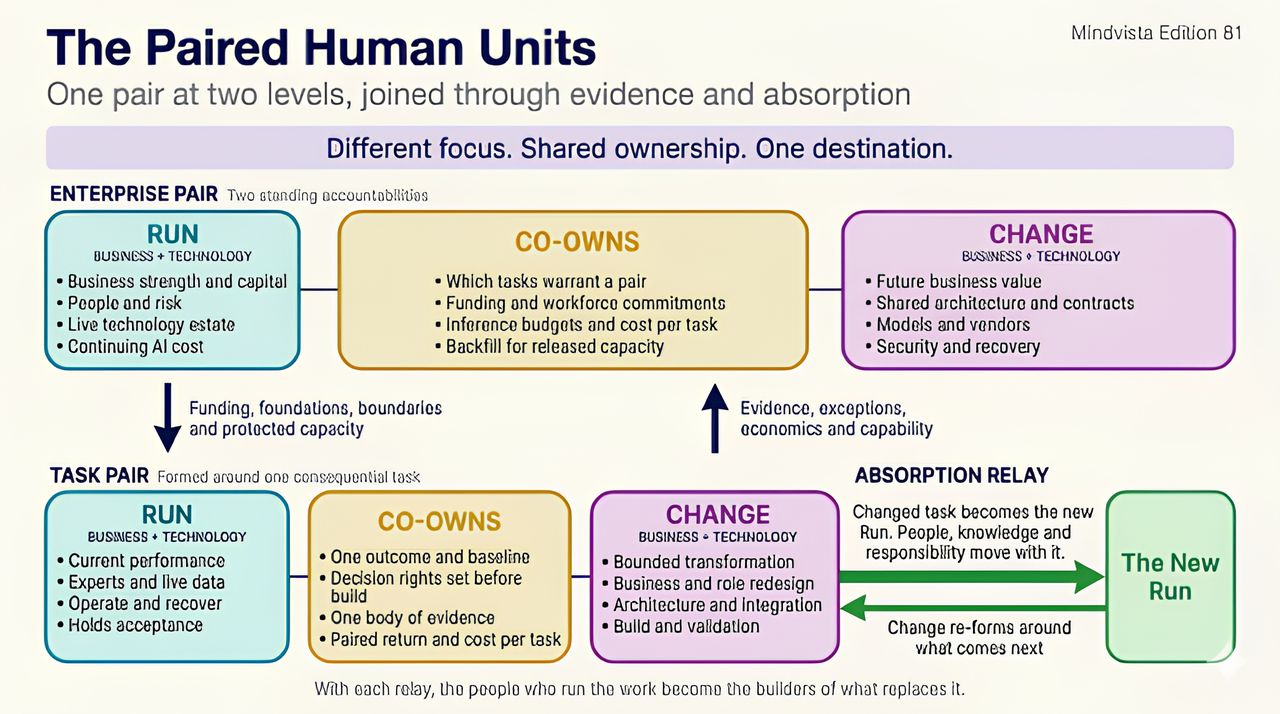
Edition 81 proposes focused, paired human units: Run, which keeps today’s business strong and funds the change, and Change, which reimagines the work, sharing one destination, one body of evidence and both returns until the change becomes the new Run. The will that holds them together must be earned: the organisation commits first, and people make the change real because it is done by them and for them. This is how everyone can become a builder of 21st-century business and a better future.
The place to begin is the change itself, and why it is so hard to carry through.
What Has Changed in the Second Age, and Why It Is So Hard
The change is easiest to see where it has gone furthest. A chart reported by The Wall Street Journal tracks Anthropic’s own research work along a spectrum of AI involvement, from none, through assisting, collaborating and leading, to full autonomy. Within a year, AI came to collaborate on or lead more than 90 percent of that work, yet none of it was fully autonomous. One frontier lab is not the enterprise norm, but it shows the direction of travel, with the line between what AI does and what people do being redrawn every few months.
For an enterprise, the unit of this change is the bounded transformation of one complete task, followed from its purpose to its consequence, which keeps it small enough to redesign, build, prove and absorb. As AI takes on more of that task, architecture must make explicit the connections people once supplied, design must decide how knowing, deciding and doing are shared, and build must deliver the business outcome while strengthening the judgement, authority and future capability of its people.
Few enterprises are yet working at this unit, which helps explain the value gap. McKinsey found that 80 percent of respondents reported individual productivity gains, while only 37 percent reported a positive contribution to enterprise earnings, and the 6 percent who qualified as high performers were three times more likely to have fundamentally redesigned their workflows. Capital is moving regardless, with more than 1,900 Anthropic customers now spending over $1 million a year and Goldman Sachs expecting the tokens consumed by AI agents to multiply about 24 times by 2030.
Making the change real is harder than the spending suggests. An agent plans, calls tools, checks its work and repeats, so a single request can consume 10 to 50 times the tokens of a chat answer, and every task it absorbs becomes a continuing cost. The model is the smaller part of that bill: McKinsey puts it at about 15 percent of an AI project’s cost, with integration, operations and change making up the rest. The change also arrives from outside, as Ethan Mollick observes, when customers’ own agents overcome the frictions that once rationed access to services and send new volume, verification and exceptions into the running business.
Initiatives often stall, in the words of Glean’s Arvind Jain, because the builders are too far removed from the friction of the actual work, and that friction lives in the running business, with its experts, data and customers. Getting the opportunity right while managing its cost and risk calls for execution few enterprises have yet assembled, with Change working one bounded task at a time beside a Run strong enough to carry it.
Run the Business: Funding and Carrying the Change
A Run strong enough to carry change cannot be taken for granted. The business gets no grace period while its leaders work out how to use AI.
The Business Fundamentals and Environment
The business must still grow revenue, protect margins, serve customers and generate cash, in a world where half the experts surveyed by the World Economic Forum expect the next two years to be turbulent or stormy. These are the known unknowns. The unknown unknowns are harder. Demand can turn, a tariff can change costs overnight, and a competitor can reset the market before the plan catches up. Only a subset of businesses turn such disruption into growth.
Run keeps the business strong through both. It holds the revenue, cash, customer trust and market position from which Change is funded, and it keeps advancing the products and services the enterprise depends on today. It is also where the change will live once it is absorbed.
The Economics That Must Fund Change
AI change needs patient money, and it thrives where the balance sheet is strong. JPMorgan could raise its 2026 technology budget to $19.8 billion because its core business is strong. Yet AI also tests that strength. Microsoft’s capital spending rose from $28 billion to $116 billion in three years, and its free-cash-flow margin fell from 30 to 20 percent. At any scale, Run creates the headroom and Change earns the right to keep using it.
Satya Nadella calls agents probably the biggest market expansion the industry has ever seen. As we argued earlier, enterprise AI cost is vendor revenue. Every gain in that market is a cost some enterprise must fund, and both sides win only when the price is matched by value. Much of that cost sits below the waterline, in integration, operations and the people who run the changed task. Run therefore funds the change twice. It pays while the change is built, and it keeps paying after the change is absorbed.
This is why AI spend is becoming an operating discipline, with 98 percent of FinOps practitioners now managing it, up from 31 percent two years earlier. The discipline counts the cost of the complete task rather than the price of a token, and it matches each task to the model that does it well enough. A cheaper task that produces more exceptions, pushes work elsewhere or weakens human judgement may only have moved the cost. Change stays bound by both returns until Run can own its economics.
The Experts, Data and Other Resources Run Supplies
Money is only one of the resources Run supplies. People in Run know where the real process departs from the formal one, which exceptions matter and how far a small failure can travel. Production data shows that reality, and customers show whether the value is real. When these are held back, change stalls. Kaufman Rossin found 73 percent of mid-market manufacturers still testing AI and none at company-wide deployment, with nearly half still working with siloed data.
Run must therefore make room for Change. It chooses what to stop, backfills the experts it lends and opens production reality to redesign. It also accepts the continuing cost, risk and ownership of what works. Practitioners responding to our last edition put it plainly: every agent needs a named owner, and buying a tool does not transfer ownership. A strong Run can still resist Change, but without one there is no dependable source of funding, expertise, data or future ownership.
People Must Lead, in Order to Build
All of these resources rest on the people already carrying the business. Whether they have the capacity and the will to build its future depends on why they must lead, the strain they already carry and how their will is earned.
Why People Must Lead
The enterprise must build tomorrow with the people who run today. AI may do more of the work, but people still set its purpose, grant its authority, judge its exceptions and own its consequences. Those closest to a task must lead its redesign, because Run will depend on their judgement after Change goes into production.
Design also decides whether a changed task leaves its people more capable or less, and whether newcomers still have room to learn. For every step AI removes, leaders must ask what judgement formed there and where it will now develop. Employment of to 25- year – olds in highly AI-exposed occupations already sits about 19 percent below the path of their peers, and without that entry route Run has no next generation of experts.
The Strain People Carry
These same people carry the business through its demands and uncertainty. Microsoft finds the average employee interrupted every two minutes, about 275 times a day, and 48 percent of employees and 52 percent of leaders say their work feels chaotic and fragmented. AI then adds work before it takes any away. BCG found that 14 percent of AI users suffer what it calls brain fry, reporting a third more decision fatigue and 39 percent more major errors than other users, driven most by overseeing AI agents.
Engagement is weak, and trust is weakening. Gallup puts global engagement at 20 percent and manager engagement at 22 percent, while trust in one’s employer, though still 74 percent, has fallen five points.
On top of this sits anxiety about the future. Even Microsoft, one of the strongest businesses in the world, has made about 60,000 employees eligible for voluntary exit while rising depreciation from its AI infrastructure build-out presses against other costs. People see roles disappear and entry routes narrow, and many now ask: if AI does everything, what is my role?
Creating the Will for Change
Will is therefore foundational: the organisation’s commitment to see change through, and its people’s motivation to make it real. It is reciprocal. People commit to what they help shape and return the support they receive, so the organisation must move first.
It must be open about its initiatives and what they mean for people’s work, and keep to a timetable people can plan around. Fairness here is not charity: it means truth about what comes next, choice where possible and speed. Prolonged uncertainty is itself unfair. People also need protected time, backfill for the experts Run lends, safety to say what is wrong, and recognition and a share in the value they help create. When the first changes give something back, people see a change made by them and for them.
AI is becoming more capable, but it has no intrinsic value to an enterprise without people. People are more than the human in the loop: they change the AI loop and they run it, which is the work of Change and Run. Will makes this possible, but it is easily spent. Run and Change draw on the same strained people, and on the same data, money and attention, so they must learn to collaborate rather than collide.
Where Run and Change Collide
The enterprise’s scarce domain, data and integration capacity sits in Run, because that is where the work is. Change needs access to it, Run’s cash funds the change, and both compete for leadership attention. For a business leader, releasing the best data owner means taking a certain hit this quarter for an uncertain gain shared later. That rational choice shows up in three ways the work breaks.
Three Ways the Work Breaks
When change is combined with Run without protected capacity, the urgent repeatedly defeats the important. Experts return to customers, data clean-up waits and funding follows the quarter, leaving pilots without complete outcomes. Deloitte found that only a quarter of enterprises have moved 40 percent or more of their AI pilots into production.
When change is isolated to protect speed, it loses operating truth. It builds against clean data and simplified processes, and then Run inherits what it cannot trust, maintain or recover. Commonwealth Bank replaced 45 call-centre roles with a voice bot, only to see call volumes rise and team leaders pulled back onto the phones. It reversed the decision and admitted it had not considered all the relevant business factors.
When change is diffused across the enterprise, tools outrun the shared contracts and architecture that should connect them, along with common economics, security and decision rights. Microsoft, Uber, Accenture and Goldman have variously moved work to internal tools, reconsidered agent spend, capped use or narrowed access. The triggers differ, from cost without visible value to review load and compliance, but uncontrolled initiative is eventually reined in.
Where Current Thinking Falls Short
Ambidexterity and the dedicated-team partnership protect Change from Run’s urgency, but they integrate at the top or at handover and treat change as a project that ends. Kotter connects hierarchy and initiative without protecting scarce capacity. Product teams integrate build and run, but usually within a product boundary rather than across the tasks of a running business.
Second Age change does not end at handover. Every changed task keeps costing money, keeps reshaping the work and capability of the people who run it, and keeps needing Run to own its outcome. The answer must give Change focus without isolating it from Run, and common foundations without smothering initiative. It must share the economics and both returns, and carry people’s will through to absorption. That calls for Run and Change to work as a pair.
The Paired Human Units: Run and Change as One
The pair is the way this edition proposes. It begins with focus, takes shape at two levels that work together, and holds only where will is earned.
Why Focus and Pairing
Pairing begins with focus, for four reasons. People already stretched cannot redesign a consequential task in the margins of a fractured day. The change itself is complex, crossing systems, authority and roles. Run and Change must resolve their conflicts quickly and close to the work. And the enterprise needs the agility of a bounded unit that can move without losing operating truth.
Focused does not necessarily mean dedicated. The form follows what the organisation has: a standing team, a rotation, a time-bound unit or protected time. What does not flex, at any size, is an accountable leader on each side, one destination, one body of evidence, joint accountability for the paired return, and terms of acceptance agreed before build, so Run holds acceptance without an open-ended veto. Where any of these is missing, it is not a pair but one team with a second set of meetings. The pair is defined by what it co-owns: the outcome, the capacity and data committed to it, the funding gates, acceptance and absorption.
The Enterprise Pair
The enterprise pair is two standing accountabilities, not a forum, each with an accountable leader. The Run side joins business strength, capital, people and risk with the live technology estate and continuing AI cost. The Change side joins future business value with the shared architecture, contracts, models, vendors, security, evaluation and recovery capability set out in our earlier editions. Both contain business and technology capability; their difference is the outcome for which they are accountable.
Together they decide which consequential tasks warrant a pair, while other bounded work moves through existing teams within the same foundations. They set funding and workforce commitments and co-own the economics, tracking inference budgets and the cost of each complete task against its value. The enterprise pair also carries the backfill and temporary dip from releasing Run capacity, so the releasing unit is made whole rather than charged against its quarter. A steering committee advises on such choices; the pair makes them and answers for both returns.
The Task Pair
At task level, Run and Change form complete human units around one outcome. Run owns current performance and eventual acceptance, bringing operating experts, live data and the technology capability to operate and recover the task. Change owns the bounded transformation, joining business and role redesign with architecture, integration, build and validation.
A reader of our last edition asked who writes the outcome definitions. The answer is both. Run and Change agree the outcome, baseline, decision rights and evidence required for acceptance before build, and only deadlock moves up to the enterprise pair. The pair reads business value, service, risk and cost per task beside human judgement, recovery, skill formation and the next generation of experts. Return on capability is judged at task and team level, never through surveillance of individual tool use.
How the Two Levels Dovetail
The enterprise level sends down funding, shared foundations, risk boundaries and protected capacity. The task level returns operating evidence, exceptions, economics, capability and recovery readiness. The enterprise pair sets the field without designing the task, and task teams move without creating their own enterprise.