In Edition 76, we asked, if everyone has to build their own life, who helps the builder? We identified readiness as key and explored the different types of help a builder could benefit from.
This edition continues that purpose by helping builders in their work who want to shape its future, are thinking about doing so, or are already engaged in it. The builder may be an individual contributor, manager, leader, specialist or generalist.
If this is you, we explore three actions that can shape the future of your work: deepen expertise, expand from role output to outcome ownership, and reimagine the context of work.
This edition also aims to help leaders. While leadership cannot build an individual’s future, leaders can make it possible by setting direction, elevating people through outcome responsibility, and building transparency and trust so people can align, act and take responsibility for growth.
This edition is not a definitive guide or a rule book. It is an approach informed by experience and
judgment, intended to help you, as a builder or leader, evaluate these actions and apply what is
useful to your own situation.
Building and leading for the future starts with what you do today.
What You Do Today Is Your Starting Context
The first step of our approach is not to imagine a future role or predict how AI may change your
profession. It is to understand the context of the work you do today and its role in creating the
outcome for the organization.
In Edition 8, we explored how your past decisions shaped your present. Where you work, what you do, whom you work with and the outcomes created by those choices form the context of your work.
The usefulness of AI at any given level of intelligence depends on its ability to apply context effectively. Human context is different and compounds through experience, relationships and judgment, but it is equally important to our ability at work.
Human context includes what makes a person unique: their capabilities, expertise and pattern recognition developed through experience. It includes the ability to connect, build relationships and trust, and understand how the organisation works. It shapes action through the judgment gained from making decisions, living with their consequences and understanding the trade-offs behind a good outcome. It also includes how colleagues see your capability, the credibility you have earned, and the decision rights and autonomy entrusted to you.
These are real assets. They allow a person to interpret situations, manage uncertainty, recognise what matters and act with judgment. They cannot be reproduced merely by accessing information or prompting an AI system.
Work Context, AI and the Future of Your Work
But the same context can also become a boundary in two ways.
- Roles are defined by functions, while the outcomes that matter often span them. You may be measured by what your function produces even when the business outcome depends on several functions working together.
- Present work rewards what is immediate and visible. Closing a sale, shipping a product, resolving a problem, completing a deliverable or meeting a target provides evidence of progress. But these success signals can consume the time, energy and attention required to develop the future of your work.
AI makes the value of human context visible. Without it, AI can produce fluent output that is generic, incomplete or misdirected without human steering.
AI can also multiply the output of that human context. But AI output growth without corresponding growth in human expertise, judgment and accountability can improve present performance while quietly weakening future capability. Deepening human expertise for the future is essential.
Second, AI and agentic systems are moving from supporting tasks towards performing more complete parts of an outcome. If AI is expected to move beyond output to outcomes , the builder cannot remain only an output producer. This requires expanding from role output to outcome ownership.
The builder’s contribution must rise towards defining the problem, integrating context, assessing what AI produces, making choices where there is no correct answer and carrying accountability for the outcome.
Third, deepening expertise and expanding outcome ownership may still be constrained by the conditions in which the work is performed. The work itself may not change as much as how people, AI, decisions and accountability come together around the outcome. This requires reimagining the context of work.
These three actions can help shape the future of your work. We will now explore each of them.
The first action is to deepen the expertise you already possess.
Deepen Expertise: AI Fluency and Human Judgment
Deepening expertise requires fluency in the use of AI and a concurrent increase in our capacity to direct, validate and control with checks and balances .
We are handicapped today by the absence of an accepted measure of AI usage maturity, a benchmark against peers, or a way to track progress. Most available measures tell us about adoption, frequency, tasks performed or prompting behaviour. They do not tell us whether we are using AI across the different kinds of work we do, providing better context, improving our judgment, converting output into outcomes or recognising when AI should not be used.
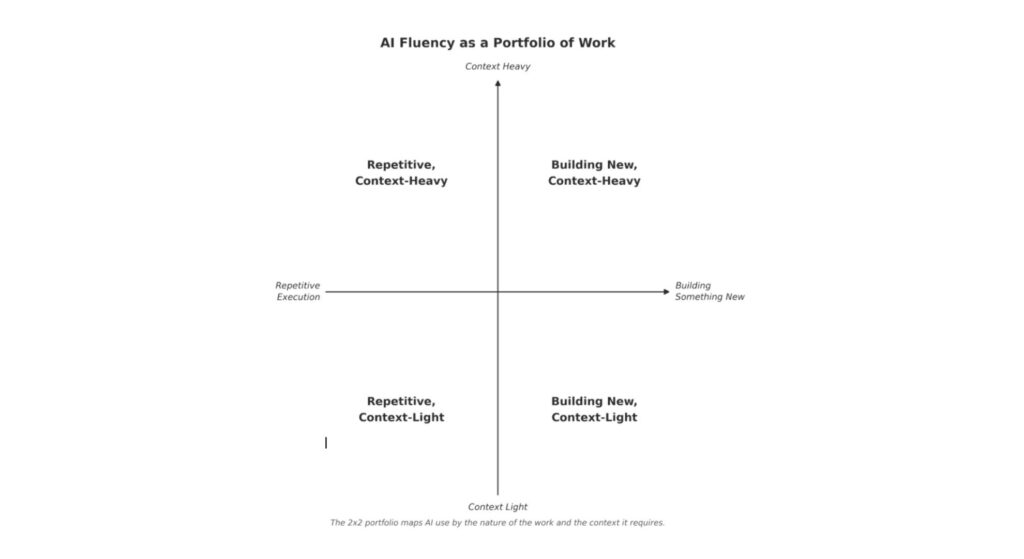
Without accepted measures, Edition 69 offered a way to assess the climb from AI literacy to fluency through a portfolio of work across two dimensions. Is the work repetitive or are you building something new? Is the context required light or heavy? The resulting 2×2 matrix creates four kinds of AI use: repetitive and context-light, building new and context-light, repetitive and context-heavy, and building new and context-heavy.
The key point of AI fluency is to develop the ability to use AI across all four quadrants, as relevant to your work.
The 2×2 does not solve the entire problem, but it can make our portfolio visible. A builder can mark where AI is being used, whether that use is occasional, repeatable, part of a workflow or contributing to an accountable outcome, and how that is changing over time.
My own use has evolved from conversational exploration in 2024 to work across all four quadrants. It now includes recurring website and LinkedIn analytics, the aggregation and synthesis of the Recharge Digest, ideation for architecture design, and the hypothesis-led research and synthesis for Mindvista. These uses are themselves evolving constantly.
But fluency in working with AI is only one side of deepening expertise.
As work becomes more context-heavy, ambiguous or consequential, human capability matters differently. The builder must frame the problem, decide what context matters, examine what AI produces, recognise omissions and errors, make choices where there is no single correct answer, and carry responsibility for the outcome.
Coincidentally, McKinsey describes the emerging T-shaped deep specialist as combining deep domain expertise with AI and higher cognitive abilities. Such specialists provide human oversight, reimagine workflows, handle exceptions and safeguard quality.
Company-reported examples illustrate this combination of AI leverage and retained human responsibility. For example, Uber reports reducing parts of performance analysis from days or weeks to hours and using AI to review code at scale. Stripe reports that its Minions produce more than 1,000 pull requests each week. Anthropic demonstrates finance workflows in which AI prepares analyses and draft narratives. In all three cases, experienced people continue to validate, interpret, approve and remain accountable for the work.
AI can therefore amplify productivity. It cannot substitute for the development of experience and judgment. A builder who accepts fluent output without continuing to think, question and learn may increase productivity while weakening the expertise required for future responsibility.
Deepening expertise means knowing what to automate, where to use AI as assisted intelligence, and how human thinking and judgment must develop concurrently.
It strengthens what the builder can do within the context of their present role and its measures of output. But that context has a boundary. The next action is to expand from role output to outcome ownership.
Expand From Role Output to Outcome Ownership
Context develops through experience and becomes rich in specific roles within functions. But the outcomes that matter usually span roles and even functions.
Marketing and sales share customer acquisition. Product management, sales, delivery and customer success share customer value. Corporate and business finance connect through cash flows, profitability and growth. Architecture, applications and infrastructure contribute to one reliable technology outcome.
Each function has its own roles, knowledge, objectives, language, relationships and measures. These provide depth, but they can also become boundaries.
Expanding from role output to outcome ownership means extending the context, experience, judgment and accountability a builder brings to a result that crosses functions. It does not mean claiming authority over every function. The builder remains anchored in a core competence while understanding and influencing more of the outcome.
AI makes this increasingly important. Edition 66 examined AI-native systems such as Clay, Sierra, Serval and Devin that go deep into a domain and connect more of its execution loop. If AI can move beyond outputs, can the builder remain responsible for only one fragment of the work? AI may execute more, but the builder must connect that execution with context, judgement, trade-offs and accountability for the outcome.
This is why mobility matters now. As AI performs more execution across an outcome, the builder needs the context, experience and judgment to understand what connects the different parts.
Working in an adjacent role or function provides lived experience of different objectives, constraints, decisions and consequences. It prepares the builder to direct AI and carry a wider outcome rather than remain responsible for one functional output. The same Mckinsey report also expects people to move from executing activities to owning and steering end-to-end outcomes as organizations adopt agentic AI.
Mobility need not be a promotion. It could be a lateral move, a temporary assignment or a planned rotation into an adjacent function. My own lived experience across sales, marketing, customer success and product management helped me understand different parts of how a customer is found, what is promised, what is built and whether value is ultimately created. Its value was not in accumulating roles but in combining these contexts in later judgment.
When mobility is not possible, accountable cross-functional execution is the practical alternative. Attending collaboration meetings, representing a function or gaining exposure is not enough. The builder must carry a real part of a business or customer outcome, participate in decisions, resolve dependencies and live with the consequences.
Research on leadership careers supports this direction without making it a rule. McKinsey found that fewer than 15 percent of 599 CEOs reached the role directly from a functional leadership position. In a related FTSE 250 sample, three-quarters of CFOs promoted to CEO had worked outside finance. Spencer Stuart’s study of more than 1,300 transitions also found broader operating roles featured prominently among the routes to CEO. Successful leaders still came from different backgrounds.
The action is to identify the wider outcome connected to your work, understand what happens before and after your contribution, and acquire the adjacent experience that would improve your judgment. While depth remains the anchor, wider accountable experience expands where and how that depth can create value.
But greater expertise and outcome ownership can still be constrained by the conditions in which work is performed. The third action is to reimagine that context.
Reimagine the Context of Your Work
Deepening expertise improves what a builder can do. Expanding outcome ownership widens what a builder can understand and carry. But both can remain constrained by the conditions in which the work is performed.
The same role and core outcome can become different work when those conditions change. Work is shaped not only by the task, but by who works together, what AI does, where decisions are made, how approvals happen, how directly the builder reaches the customer or problem, and how control and accountability are assigned.
The McKinsey report provides one view of how significantly these conditions may change. Its evolution of operating models moves from functional hierarchies to cross-functional product teams and then to flatter networks of hybrid agentic teams organised around end-to-end outcomes. The human team owns and supervises the AI workflows. People steer outcomes, apply judgment, manage exceptions and retain accountability.
AI does not automatically create these conditions. Adding AI to a fragmented workflow may only make the fragmentation operate faster. Reimagining the context requires the workflow, team, decisions, controls and accountability to be considered together.
This does not necessarily require a different role or employer. Your current organisation can also create different conditions for emerging work. New business units or initiatives may have their own processes, structures and measures while remaining connected to senior leadership and the organisation’s expertise, customers, talent, capital and trust. Research on ambidextrous organisations shows how this can protect new work from being overwhelmed by business as usual without isolating it from the assets that help it succeed.
A builder can make the case for changing the conditions around a consequential outcome. The builder could propose or participate in the redesign of one recurring workflow, an AI-first lighthouse initiative, an emerging business unit or a bounded intrapreneurial effort. The case should clarify the outcome, what AI could do, where human expertise and judgment remain essential, what decisions the team must make, which controls must be retained and how success will be assessed.
The builder can then participate, make decisions, live with the results and help determine what should be retained, changed or scaled. The expertise and wider context developed through the first two actions prepare the builder to do that.
If there is no sponsorship or room for meaningful change, another unit, organisation, AI-native company or startup may provide a different context.
The builder can make the case and step forward. But leadership must decide how to provide the direction, authority, resources and organisational support that make it possible.